Solutions overview
 Account take over (ATO)
 Digital Impersonation
 Credit card data theft
 Man in the Middle (MitM)
 Credential stuffing
 SEO poisoning
 For security teams
 For fraud/risk teams
 For digital business teams
 Library
 Blog
Blog Glossary
 Partner Up
 About
About News
News Events
 Careers
 Contacts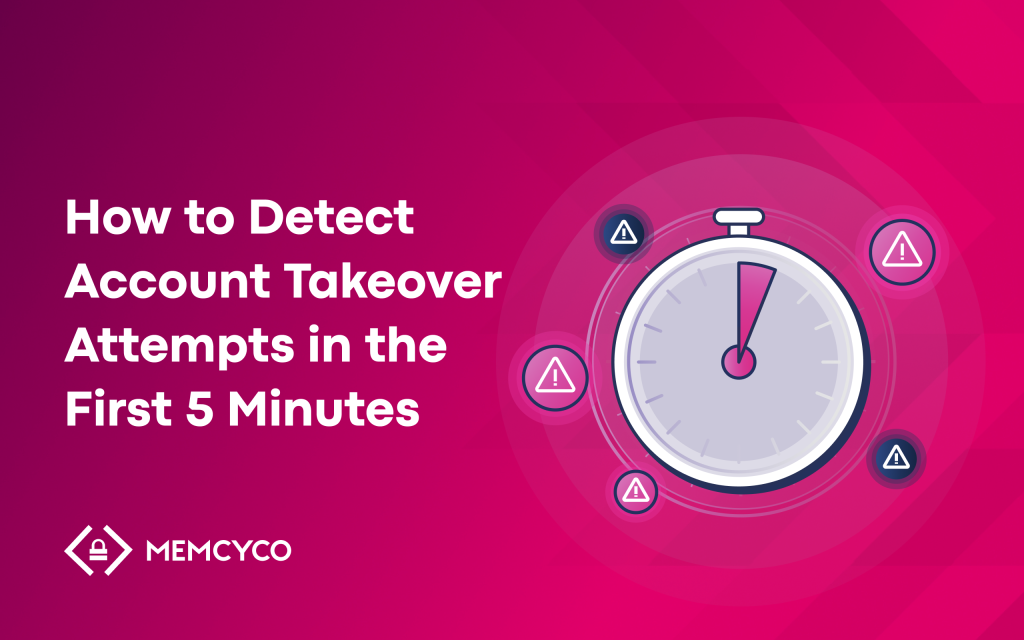
Most ATO detection tools are watching the wrong moment. Attackers don’t start at your login page – they start days earlier, registering lookalike domains, cloning your site, and harvesting credentials before your stack sees a single signal.
Knowing how to detect account takeover means moving detection upstream: to the reconnaissance stage, the cloning event, and the live harvesting window. That’s where the attack is stoppable. By the time a suspicious login appears in your logs, the damage is often already done.
This guide covers the five attacker footprints visible before any login attempt, why takedowns and behavioral analytics leave a structural blind spot, and what a pre-login detection posture actually looks like in practice.
Why the First 5 Minutes Define Whether an ATO Becomes a Catastrophe
Your login page isn’t where account takeover begins. It’s where it ends.
By the time a fraudulent login hits your authentication layer, the attacker has already cloned your site, harvested credentials, and replayed sessions. Sift’s Q3 2025 Digital Trust Index projects ATO losses will reach $17 billion in 2025. Vectra AI reports attacks surged 250% in 2024.
Most stacks still measure “successful detection” at login. That’s the catastrophe point: stolen credentials become reusable at scale, turning one phishing incident into an automated campaign targeting thousands of accounts.
The first five minutes is your blind spot.
Before You Begin: What This Guide Assumes
This guide is for advanced practitioners with MFA, behavioral analytics, or SIEM already deployed. It assumes ATO fluency and adds one thing: a structural reframe of where detection must start. Reading time: 12 minutes.
The Modern ATO Kill Chain: What Attackers Do Before They Ever Touch Your Login Page
By the time a victim types their credentials, the attacker has already run an eight-stage operation.
- 1. Reconnaissance – Target selection, login page mapping, MFA mechanism identification.
- 2. Infrastructure setup – Typosquatted domains registered, valid TLS certificates provisioned in minutes.
- 3. Site cloning – Pixel-perfect replicas built using tools like HTTrack or commercial phishing kits.
- 4. SEO poisoning and multi-channel distribution – Cloned sites surfaced above legitimate ones, amplified via smishing, email, and social lures.
- 5. Credential harvesting – Victims enter real credentials directly into attacker-controlled environments.
- 6. MitM session relay – Kits like Evilginx2 and Tycoon 2FA proxy sessions in real time, bypassing MFA and stealing session tokens.
- 7. Credential validation and packaging – Harvested data is tested, sorted, and sold.
- 8. Account takeover and monetization – Credential stuffing, account draining, loyalty point theft.
Barracuda found that phishing kits doubled in 2025, with 90% of high-volume campaigns running on PhaaS platforms. These aren’t opportunistic emails. They’re end-to-end SaaS operations. The Ontinue 2025 H1 Threat Intelligence Report confirmed the timeline from phishing to full account access has compressed to hours.
Stages 1-4 occur entirely outside your application. Every in-path control you have is blind to them.
Stage 1: Reconnaissance and Infrastructure Setup
Attackers register lookalike domains and provision valid TLS certificates via Let’s Encrypt automation in under five minutes. The cloned site looks legitimate before a single victim arrives. These activities leave observable signals in certificate transparency logs and domain registration patterns, but only out-of-path monitoring catches them.
Stage 2: Cloning, Distribution, and Live Harvesting
Modern phishing kits clone sites to pixel-perfect fidelity, dynamically mirroring content in real time. Distribution spans SMS, social ads, email, and, as Zscaler and VMRay confirm, SEO poisoning that surfaces fake sites in organic search. When a victim enters credentials, MitM proxies relay them instantly to the real site, generating a valid session. That’s when the 5-minute clock starts.
Stage 3: Credential Reuse, Validation, and Takeover
Bots validate stolen credentials in seconds. 52% of login attempts involve leaked credentials, per NordPass, cited by Mitek Systems. Sift’s Q3 2025 Digital Trust Index confirms automated conversion happens almost instantly.
Traditional in-path tools first see the attack at this stage. By then, it’s already over.
Proof of Identity vs. Proof of Source Authenticity: Why You’re Asking the Wrong Question at the Wrong Time
Every ATO control you have asks one question: Who is this user? Passwords, MFA, biometrics – all Proof of Identity (PoI), evaluated at login.
If your customer is on a cloned site, PoI is irrelevant. The attacker already has their credentials before your authentication system sees a single request.
Proof of Source Authenticity (PoSA) asks something different: Is the environment this user is interacting with actually your application?
PoI is checking ID at your bank’s door. PoSA is knowing someone built a fake branch down the street and is sending your customers there.
Cloning, infrastructure setup, harvesting – all observable before any victim reaches your login page. Memcyco’s PoSA detects these signals via Nano Defenders embedded in your legitimate assets.
The 5 Attacker Footprints You Can Detect Before Login
These aren’t IP velocity spikes or bot scores. These are attack-technique-specific signals, invisible to in-path tools, that surface before a single credential is entered.
- 1. Cloned infrastructure setup
Attack stage: reconnaissance and site cloning. Newly registered lookalike domains, mirrored page structures, and freshly issued SSL certificates are detectable via out-of-path monitoring. Your WAF sees none of this.
- 2. SEO poisoning and redirect abuse
Attack stage: victim targeting. Malicious pages engineered to outrank your legitimate site, or redirect chains funneling traffic away, are visible in external crawl data. In-path tools only see users who arrive.
- 3. MitM proxy session patterns
Attack stage: live credential interception. Adversary-in-the-middle phishing kits relay sessions in real time. Proxy fingerprints and session relay behavior are detectable before harvested credentials are replayed.
- 4. Active credential harvesting events
Attack stage: harvesting. Victims interacting with attacker-controlled environments generate telemetry outside your application perimeter. Your SIEM never receives it.
- 5. Unknown-device logins post-phishing exposure
Attack stage: pre-takeover. A confirmed phishing exposure followed by a new-device login is a near-certain ATO signal. Without real-time harvesting visibility, you’re correlating blind.
Footprint 1: Cloned Infrastructure and Domain Registration Patterns
Typosquatted domains, freshly issued SSL certificates visible in Certificate Transparency logs, and pixel-perfect HTML clones appear before any victim clicks. Your WAF sees none of it.
Detect here and you’re issuing takedown requests and user alerts before a single credential is harvested.
Footprint 2: SEO Poisoning and Redirection Abuse
Attackers optimize cloned sites to outrank your brand in search results. Zscaler confirms SEO poisoning is an active credential theft vector. In-path tools can’t see search rankings. Brand keyword monitoring catches rogue domains before victims click.
Footprint 3: MitM Phishing Proxy Session Replay Patterns
Tools like Evilginx2, Tycoon 2FA, and Modlishka relay sessions in real time, capturing credentials and session tokens simultaneously and bypassing MFA entirely. Sekoia identified 11 active AiTM kits in 2025; Barracuda confirmed PhaaS kits doubled that same year.
When a Nano Defender-instrumented session is relayed through a proxy, timing anomalies and JavaScript execution differences expose the relay. That’s not a probabilistic alert. It’s deterministic proof of a proxied session, triggering immediate invalidation and targeted user outreach.
Footprint 4: Credential Harvesting Activity in Attacker-Controlled Environments
Nano Defenders travel with cloned assets into the attacker’s environment. When a victim interacts with the fake site, they execute and report back, identifying exactly which user is being targeted.
Harvesting becomes visible and attributable before credentials are ever reused.
Footprint 5: Unknown-Device Logins After Confirmed Phishing Exposure
When a user already flagged through footprints 1-4 logs in from an unknown device, that’s not an anomaly score. It’s confirmation.
Device DNA creates a persistent attacker fingerprint that survives IP rotation, VPN switching, and residential proxy evasion, linking the login attempt directly to the harvesting event.
From Detection to Disruption: How Deception Changes the Math
Most fraud defenses wait for a signal. The Poison Pill approach plants one.
When a victim enters credentials into a cloned site instrumented with Nano Defenders, the system substitutes real data with marked decoy credentials. The attacker stores them, none the wiser. When those decoys surface in a login attempt, no probabilistic inference is needed. It’s deterministic proof of a harvesting event.
The downstream effects compound:
- The attacker’s entire credential dataset becomes suspect. They can’t distinguish real from decoy, making the whole haul a liability
- Decoy reuse triggers immediate account protection, no fraud score threshold required
- Device DNA ties that login attempt to a specific attacker device, persisting across IP rotation and VPN evasion
This is infiltrating the attack timeline, not watching it from the outside.
As Frost & Sullivan noted in February 2026: organizations relying on reactive fraud detection are increasingly outpaced. Preemptive disruption, operating inside the attacker’s own workflow, is where the math finally changes.
The Takedown Blind Spot: What Happens Between ‘Rogue Site Live’ and ‘Site Removed’
Takedowns feel like a win. They’re not a control.
Research from the 2025 WWW Conference (Lee et al.) found phishing sites average 54 hours of active life, with a median of 5.46 hours. CloudSEK reports an average takedown turnaround of 4.1 business days. The damage happens in the gap.
During that window, credentials are being harvested and your team has zero visibility into who was hit. That leaves two bad options: wait for fraud signals post-login, or force broad password resets that punish every customer, including the 95% who weren’t touched.
Early detection at the reconnaissance and harvesting stages creates a third option: targeted response for confirmed exposed users, while takedown runs in parallel.
SOC Impact: Fewer Alerts, Faster Response, Targeted Action
95% of fraud alerts are false positives. Splunk’s State of Security 2025 found 57% of security teams lose valuable investigation time to data gaps. That’s the SIEM reality: high volume, low context, exhausted analysts.
PoSA flips this. Each alert maps to a confirmed attacker action: a cloning event, a harvesting event, decoy credential reuse. No statistical inference required. Memcyco customers have seen up to 90% reduction in investigation time.
PoSA also identifies which specific users were exposed during a phishing campaign. Fraud teams apply step-up authentication or account resets to exactly those users, not everyone. That precision stops fraud without degrading customer experience. SIEM Integration APIs feed these attack-lifecycle signals directly into existing workflows, enriching your stack without replacing it.
Reducing analyst fatigue with deterministic signals
Probabilistic signals, IP velocity, device anomaly scores, require investigation to confirm whether fraud actually occurred. Every alert consumes analyst time, even false positives.
Deterministic signals work differently. A confirmed cloning event, a confirmed harvesting event, decoy credential reuse: the event is the proof. No investigation needed. Analysts respond instead of chasing maybes.
Targeted response vs. broad friction: protecting customer experience
Broad controls applied after a suspected phishing campaign create friction for every user, including the 99.9% who weren’t exposed. If 500 users interacted with a rogue site out of 500,000, targeted response affects only 0.1%. The unexposed majority experience zero disruption.
What early ATO detection looks like in practice: a detection checklist
Run this as a gap analysis against your current stack.
- Tier 1: Pre-attack infrastructure
- Can you detect brand asset cloning before any victim interacts with the fake site? (No = blind to reconnaissance)
- Do you monitor SSL certificate issuance for domains mimicking your brand? (No = attackers set up undetected)
- Can you identify SEO poisoning or redirect abuse targeting your brand in real time?
- Tier 2: Active harvesting
- Do you have visibility into credential harvesting occurring outside your application perimeter? (No = zero pre-login signal)
- Can you detect MitM proxy session patterns before login attempts reach your platform?
- Do you know which specific users interacted with a rogue site during its live window?
- Tier 3: Credential reuse
- Do you receive alerts when decoy credentials from a phishing campaign appear in a login attempt?
- Can you track an attacker’s device across IP rotation and VPN evasion?
- Does your SIEM receive pre-login attack-lifecycle signals, or only post-login authentication anomalies?
If you answered ‘No’ to more than three questions, your detection perimeter starts too late.
Where ATO detection is heading: the ‘first 5 minutes’ as the new baseline
The attack timeline isn’t slowing down. The Ontinue 2025 H1 Threat Intelligence Report found phishing-to-full-account-access now compresses to hours. Barracuda recorded a doubling of phishing kits in 2025, with 90% of high-volume campaigns running on PhaaS automation. Catching fraud at login is already obsolete.
Operating across attack lifecycle stages 1-3 is the new enterprise baseline. Frost & Sullivan’s 2026 analyst brief validates this shift, spotlighting Memcyco’s preemptive approach as the model for early intervention.
Use the detection checklist above. Map your coverage against each kill chain stage. Your gaps are where the next ATO forms.
Frequently Asked Questions
- What are the first signs of an account takeover attempt?
The earliest indicators are usually behavioral, not technical. Watch for logins from unfamiliar locations or devices, multiple failed authentication attempts, password reset requests the user didn’t initiate, and session activity at unusual hours. These signals often appear before any damage is done.
- How do you detect account takeover in real time?
Real-time detection requires continuous monitoring of login behavior, device fingerprints, and session patterns. When activity deviates from a user’s baseline, such as a new device, a different IP range, or an atypical access time, automated alerts should trigger immediately. Waiting for post-session analysis is too slow.
- What’s the difference between account takeover and credential stuffing?
Credential stuffing is one method attackers use to execute an account takeover. It involves automated tools testing large volumes of stolen username and password combinations across multiple sites. Account takeover is the broader outcome: unauthorized access to a legitimate account, achieved through credential stuffing, phishing, or other means.
- How quickly can an account takeover cause damage?
Very quickly. Once an attacker gains access, they can exfiltrate data, initiate fraudulent transactions, or lock out the legitimate user within minutes. The five-minute window after a suspicious login is critical. Detection and response need to happen in that same window.
- Can multi-factor authentication prevent account takeovers?
MFA significantly raises the bar, but it’s not a complete defense. Attackers use SIM swapping, real-time phishing proxies, and MFA fatigue attacks to bypass it. MFA should be part of a layered strategy, not treated as a standalone solution.
- What tools help detect account takeover attempts?
Effective detection typically combines SIEM platforms, behavioral analytics, device fingerprinting, and threat intelligence feeds. Some organizations also deploy purpose-built ATO detection tools that correlate signals across sessions and flag anomalies before they escalate.
- How does phishing contribute to account takeover?
Phishing is one of the most common entry points. Attackers use fake login pages to harvest credentials in real time, often relaying them instantly to the legitimate site to avoid triggering MFA timeouts. Detecting the phishing infrastructure early, before credentials are entered, is the most effective countermeasure.
Conclusion
ATO attacks don’t start at login – they start with infrastructure. The five pre-login footprints covered here are detectable, and acting on them early is what separates containment from catastrophe. Behavioral analytics and MFA remain important, but they can’t cover what happens before an attacker ever reaches your authentication layer. Pre-login visibility closes that gap.
See Where Your Detection Coverage Actually Ends
Evaluate your current ATO detection posture against the full attack kill chain – including the pre-login stages most tools are structurally blind to. Get a personalized coverage assessment from Memcyco’s team.
Request Your Coverage Assessment
FAQs
Q: What are the earliest signs of an account takeover attempt?
A: The earliest detectable signs of an ATO attempt occur before any login is attempted. These include: newly registered domains mimicking your brand (visible in Certificate Transparency logs), SSL certificates issued for typosquatting domains, cloned versions of your site appearing in search results or being distributed via phishing campaigns, and SEO poisoning that surfaces non-legitimate domains for brand-name queries. Most organizations only detect ATO at the login stage – failed authentication attempts, unusual device fingerprints, or geographic anomalies – but by this point, credentials may already be harvested. Pre-login monitoring of your brand’s digital footprint is the only way to catch attacks at their earliest stage.
Q: How do MitM phishing attacks bypass MFA, and can they be detected?
A: Adversary-in-the-Middle (AiTM) phishing attacks use reverse proxy tools (such as Evilginx2, Modlishka, or Tycoon 2FA) to relay sessions between the victim and the legitimate site in real time. When the victim completes MFA on the fake site, the proxy forwards the MFA response to the real site and captures the resulting session token, effectively bypassing MFA entirely. Detection requires out-of-path monitoring: when a legitimate site receives a session relayed through a proxy, timing anomalies, header patterns, and JavaScript execution environment differences can identify the relay. Barracuda research found AiTM phishing kits doubled in 2025, making this detection capability increasingly critical.
Q: Why do phishing site takedowns fail to stop account takeover fraud?
A: Takedowns are a downstream control, not a primary defense. Research published at the 2025 WWW Conference found the average phishing site lifespan is 54 hours, with a median of just 5.46 hours, meaning many sites are taken down quickly, but the credential harvesting occurs in the first hours of operation. CloudSEK reports an average takedown turnaround of 4.1 business days. During the pre-takedown exposure window, victims are actively interacting with the rogue site and credentials are being harvested with no real-time visibility. Takedowns stop future victims but do not protect those already exposed, making real-time detection during the exposure window essential.
Q: What is the difference between behavioral analytics and pre-login ATO detection?
A: Behavioral analytics operates on your legitimate application’s data. It analyzes login patterns, transaction behavior, and device characteristics to identify anomalies that suggest a compromised account. It is inherently reactive: it requires the attacker to interact with your application before generating a signal. Pre-login ATO detection operates outside your application perimeter, monitoring for attacker activities (site cloning, credential harvesting, MitM session relay) that occur before the attacker ever touches your login page. The two approaches are complementary, not competing, but behavioral analytics alone leaves a structural blind spot covering the entire pre-login attack lifecycle where most modern ATO attacks are executed.
Q: How can security teams reduce false positives in ATO detection without missing real attacks?
A: The root cause of high false positive rates in ATO detection is reliance on probabilistic signals – IP velocity, device anomaly scores, behavioral deviation percentages – that require investigation to confirm whether they represent real fraud. ClearMe research found 95% of fraud alerts are false positives. Reducing false positives without reducing detection coverage requires shifting toward deterministic signals: confirmed attacker activities (cloning events, harvesting events, decoy credential reuse) that are self-evidently fraudulent and require no investigation to confirm. Attack-lifecycle-correlated signals from pre-login monitoring produce this signal quality, enabling security teams to respond to confirmed events rather than investigate probable ones, reducing investigation time by up to 90% according to Memcyco’s documented customer outcomes.

Digital Impersonation Fraud Specialist